Columbo was feeling a bit under the weather when he walked into the Van Wick mansion — but “Playback” still manages to feel unusually modern for 1975. It’s an episode about money, ego, and the seductive idea that technology can build an “airtight” alibi.

Playback debuted on March 2nd, 1975 and was the 5th episode of season 4, and I currently have it ranked 31st overall...so right about in the middle. You can read the current rankings list, here.
Meet Harold
Our killer is Harold Van Wick (Oskar Werner), president of Midas Electronics and the kind of man who values precision. He lives in a home that looks like the future: closed-circuit cameras, monitors, timers, and automated systems ostensibly designed to make life easier for his wife, Elizabeth (Gena Rowlands), who uses a wheelchair.
Despite his apparent adoration for his wife, I can’t help
but wonder if she’s just an excuse for him to tinker with more devices and gadgets.
And a pathway to him leading her mother’s electronics company. Certainly, his
philandering undercuts any idea that he’s unwaveringly devoted to her. Him awkwardly flirting with Marcy at the gallery was a little cringy.
Oskar Werner brought a complicated story to the set with
him. He had been a highly regarded actor – even an academy award nominee – but he
was notoriously difficult to work with, in part because he had a problem with
alcohol. But Colombo’s producers thought he would be a good choice for the villain
so they called him up and persuaded him to come to L.A. He allegedly arrived prickly…and drunk. And
his early days on set were problematic. He had trouble remembering his lines
and apparently one day was so drunk they had to cancel filming for the day.
But eventually he got it together and was able to finish the
episode successfully.
The real problem is Margaret
Harold isn’t fighting burglars — he’s fighting his
mother-in-law, Margaret (Martha Scott), the true power behind the company.
She’s furious about the firm’s declining profits and blames Harold’s expensive
gadget obsession. Worse, she intends to replace him with her son Arthur (Robert
Brown). And if Harold doesn’t cooperate? Margaret is ready to tell Elizabeth
about Harold’s wandering eye.
Martha Scott is terrific here: part boardroom tyrant, part
icy aristocrat. She isn’t a sympathetic victim — which is exactly why the
episode’s first act works. You can feel Harold counting the minutes until he no
longer has to smile politely while Margaret hands him his own head. She’s so
domineering that you’re almost rooting for Harold. Almost.

That said, “obsession with gadgets” seems like a curious
criticism given that he’s the president of an electronics company. Presumably
such an obsession helps him develop and improve the products the company sells.
Let’s talk about Elizabeth for a moment
Gena Rowlands plays Elizabeth, and no she wasn’t a wheelchair
user in real life. She was, however, married to John Cassavetes (Murderous
conductor Alex Benedict from Etude in Black), and a good friend of Peter Falk.

She gives a solid performance as Elizabeth, right down to
her precision wheelchair driving skills.
The “Playback” trick
Harold’s plan is elegant in a very Columbo way: it’s
complicated, it’s theatrical, and it depends on everyone trusting the shiny
system more than their own eyes.
The essentials:
- He feeds the guard a pre-recorded “empty room” video while the real study is anything but empty.
- He uses the camera’s framing — and its blind spots — to keep himself off tape while still triggering a recording.
- He schedules the murder footage to play later, so the guard sees the shooting after Harold is already establishing an alibi at an art gallery.
I can't help but wonder how long Harold had been planning this killing. He obviously staged the break-in before even meeting with Margaret, so perhaps he anticipated that she was going to fire him.
The alibi
Columbo arrives (sniffling, polite, and already unconvinced)
The gatehouse detail

The creepy clown experiment
Does he work there?
Michael Lally appears

The gotcha: the system records the truth

Nobody in the episode seems to catch it or mention it. Just a production goof.
Plot holes
The doors
The cameras
The back door
The gun

Silver walls?
I get that they make the room look more high-tech, but I was
never quite sure why Harold’s security room seems to have metal walls.
The alibi
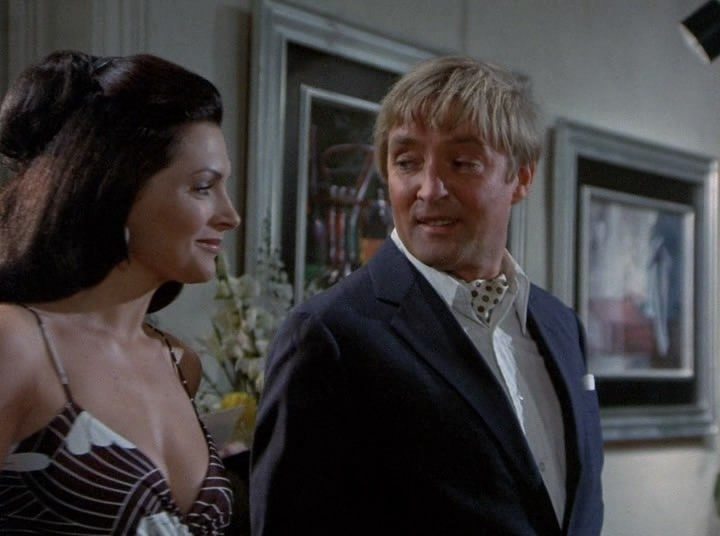
Harold goes to the Grant Gallery for his alibi and there we get
to meet Marcy (Trisha Noble) – routinely considered one of the 5 most beautiful
women ever to grace the screen on Columbo.
Years later Ms. Noble played "Jobal Naberrie" in
Star Wars III: Revenge of the Sith.
Columbo arrives (sniffling, polite, and already unconvinced)
Columbo walks into the case with a bad cold and an even
worse feeling about the story he’s being told. Harold offers a neat
explanation: a staged break-in, a startled intruder, a frightened victim — and
video proof that supports the timeline. But Columbo’s instinct is less about
gadgets and more about people: the story feels rehearsed.
The gatehouse detail
One of Columbo’s earliest “hmm” moments has nothing to do
with cameras. It’s about routine. Normally, Harold follows a set procedure with
Baxter, the gatehouse guard. But on the night of the murder, Harold does it
differently in a way that makes his gallery phone
number conveniently easy to find. It’s a tiny behavior change, and it’s exactly the
kind of thing Columbo never lets go.
Low-tech policing vs. high-tech murder
For all the episode’s futuristic trappings, a lot of the
investigation is refreshingly old-school: Columbo in the dirt, studying the
supposed entry point. Do the footprints make sense? Does the mess outside match
what’s inside? If someone fled in panic, would the evidence look this tidy?
Hmm...but...
When Columbo and Harold go back down to the laundry room it looks like the cut window has been fixed...but they left the wire that was bypassing the alarm system?

The creepy clown experiment
“Playback” also gives us one of Columbo’s best ‘parlor
trick’ demonstrations. Elizabeth describes waking up and noticing familiar
objects in her room — including a truly unsettling clown doll. Columbo
recreates the lighting and the door movement, showing how a small mechanical
effect can change what Elizabeth thought she saw, and (more importantly) when
she thought she saw it.
It’s classic Columbo: he looks like he’s fussing over a detail, but he’s really testing the whole timeline — and watching Harold’s reactions while he does it.
The diner replay that cracks it open
The title finally pays off in the most delightful way:
Columbo gets his spark from a literal replay on a TV screen. Seeing a sports
broadcast use instant replay nudges him to the answer — compare ‘before’ and
‘after,’ and the truth pops out in the difference.
Does he work there?
Always struck me as odd that at the beginning of the diner
scene Columbo appears to be coming from behind the counter. Could be he’s just
a friendly regular and nobody thinks twice about it, but it seemed odd to me.
Michael Lally appears
If one of the patrons in the diner looks familiar…that’s
because he’s the legendary Michael Lally.

The gotcha: the system records the truth
Columbo’s endgame is satisfyingly clean. He spots a
discrepancy between recordings from before and after the murder — a small,
practical detail that shouldn’t change if Harold’s story is true. And then
comes the fatal irony: Harold needs a physical object from the desk in the
study to access the party that ‘proves’ his alibi. If the tape shows that
object still in place after the murder, Harold’s timeline collapses.
It’s not that the technology failed. It did exactly what it
was supposed to do: it captured reality. Harold’s mistake was believing that
‘recorded’ automatically means ‘unquestionable.’
And Oskar Werner nails the meltdown that Harold has when his
story starts to fall apart. Ultimately he surrenders when Elizabeth shows she’s
not going to cover for him. And this is yet another episode where the murderer
is taken into custody without handcuffs.
And a small goof
If you watch the playback of Margaret getting shot, when the shot rings out you see a bit of smoke caught on the video...probably from the off-screen gun that was used to make the gunshot. The problem is that the smoke appears at the top LEFT of the screen, but the gunshot was supposed to have come from the right of the screen.
Nobody in the episode seems to catch it or mention it. Just a production goof.
Plot holes
I have a few problems with this episode and most of them
have to do with the house.
The doors
First off, the doors. Harold sometimes opens them with a
clap and sometimes with a little remote. It’s not clear why he uses different
methods at different times – you’d think he’d just open them the same way every
time.
Second…he’s standing in the foyer and he claps to open the front
door…why don’t all the other doors around him open too? How do the doors know
which door he wants to open or close?
Third…If you can clap to open it from inside, can’t you just
loudly clap to open it from outside too?
I get that the doors were an essential plot device – the gunshot
opening Elizabeth’s door – but they seem highly problematic to me.
The cameras
There’s a camera in the den, ok. But there’s also a camera
in the foyer (we see that shot several times). Harold rigs the camera in the
den with the timer, but he never does anything with the camera in the foyer. Wouldn’t
it have seemed odd to Baxter that he didn’t see Harold walk through the den
when he suddenly emerged in the foyer when he was leaving? He would have seen
Margaret walk through the foyer on her fatal trip to the den too…but she didn’t
arrive in the den until 20 minutes later?
The back door
The premise is that the robber/killer entered through the
back door of the den, but how did he get there? I suppose we can accept that it’s
a large house with a complex floor plan but seems like he would have had to
take a circuitous route to get to that back door. When Columbo and the sergeant
go down to the laundry room they go the other way, through the foyer.
I’m having a hard time picturing the route the robber would
have had to take to loop all the way around to the back of the den. And if he
didn’t do it to avoid the cameras then why? And if he did do it to avoid the
cameras then how did he plan to avoid the camera facing the safe?
The gun
What did Harold do with the gun after the murder? And where did
he get it? Hardly any mention of it is made in this episode. Do most electronics
company presidents just have unregistered pistols handy?
The safe
Just a small thing, and not really relevant to the crime I guess, but it seems odd to me that a wall safe would be installed in an exterior wall. For one thing the wall probably wouldn't be thick enough to contain a safe, but also seems like a knowledgeable and determined thief could break into the safe from the outside of the house.
Just a few more things…
- Harold’s fatal flaw isn’t ‘trusting technology’ — it’s trusting himself. He assumes no one will scrutinize the system the way he built it.
- This is one of the few episodes in the series where Columbo holds a gun and the only episode where he fires one.

- Herbert Jefferson Jr. (Baxter) will be familiar to a lot of TV fans; he later played Boomer on the original Battlestar Galactica.
Comments
Post a Comment