If you’ve ever met a Columbo fan who says they love every single episode equally, they either haven’t seen Last Salute to the Commodore or they’ve seen it and decided to embrace the chaos. Truth be told this isn’t my least favorite Columbo, but it’s in my bottom 5. It's the final episode of season five.
Directed by Patrick McGoohan, this is the episode that sails the series out of its usual comfortable harbor and into something closer to an off-kilter ensemble whodunit: no on-screen murder, a prime suspect who becomes a second victim, and Columbo behaving…well, a bit oddly
Meet the Commodore
Commodore Otis Swanson is a retired naval officer and a
shipbuilding man who’s grown tired of what his company has become under the
management of his son-in-law, Charles Clay. On the night of his birthday party,
the Commodore announces a major change: he intends to sell the business. Which
is basically a starter pistol for murder motives.
The good news is that Swanson is played by John Dehner, who
gave us an excellent turn as Mr. Pangborn, the FAA investigator in Swan Song.

The bad news is that Swanson is the first victim in this
episode, so Dehner doesn’t have much chance to save this episode.
The suspect list is the point
A big part of the episode’s identity is its suspect ensemble
— and the show makes sure you meet everyone with a reason to hate (or fear) the
old man:
- Charles “Charlie” Clay (Robert Vaughn): the slick son-in-law running the business.
- Joanna Clay (Diane Baker): the Commodore’s daughter, openly unhappy and drinking hard.
- Swanny Swanson (Fred Draper): the Commodore’s middle-aged nephew (and the episode’s eventual reveal).
- Jonathan Kittering (Wilfrid Hyde-White): the lawyer, always orbiting the money.
- Wayne Taylor (Joshua Bryant): the shipyard manager, stuck between pride and payroll.

A Columbo episode that doesn’t *start* like Columbo
Most episodes give you the killer up front. Here, neither
murder is shown on-screen — and the episode plays with uncertainty in a way the
1970s run almost never does. We see Clay disposing of the Commodore’s body at
sea and it’s easy to assume we’re in for a standard ‘howcatchem.’ But that
assumption becomes the episode’s first big feint.
Columbo locks on to Clay early, only to have the
investigation pull the rug out: Clay winds up dead too, and suddenly the story
has to do something else — it has to *be* a whodunit.
⭐Unfortunately, because of the hidden murderer gambit, we’re
basically denied what is the most fundamental pleasure of Columbo – watching
the good Lieutenant outwit an arrogant genius. Instead, he’s just rambling
around the yacht club hoping to stumble on clues.

Columbo’s vibe is… different
If you’re used to the Lieutenant’s soft-voiced charm
offensive, this one can feel like you walked into the wrong party. He’s more
agitated, he’s quicker to snap, and he’s unusually physical — grabbing,
pulling, poking around, and generally behaving like a man who’s had too much
coffee and not enough sleep. He’s right up in people’s personal space over and
over, constantly touching people, practically sitting on Charles Clay’s lap a
couple of times.

Some of that may be McGoohan’s direction (he leans into
eccentricity), and some of it is a conscious attempt to freshen the formula
late in Season 5. The result is that Columbo feels less like a rumpled chess
master and more like a slightly feral bloodhound.

And he’s not alone
Another big departure: Columbo works closely with two other
officers, who sometimes handle questioning themselves. Bruce Kirby plays
Sergeant George Kramer (a familiar face in the series), and Dennis Dugan plays
Sergeant Theodore “Mac” Albinsky, a young cop clearly studying Columbo’s every
move.

But their interactions are often painfully awkward. Mac awkwardly
introducing everybody on the yawl or Columbo and Fred yelling at each other in
the boatyard. I guess it was supposed to be funny, but I just found myself
waiting for those scenes to end. The boatyard scene with Fred lasts nearly 4
minutes. Kramer holding the lamp up for a very long time…did none of them have
a flashlight?
And the final gotcha scene…well, that was just hard to
watch.
In case we ever have to give chase?
Let’s talk for a sec about the driving scene… Columbo having
“Mac” drive his car in circles around the driveway while they’re all crammed in
“in case they ever have to give chase”? In a ’59 Peugeot? And nobody questions
that concept?

Meet Charles Clay
Robert Vaughn has an unusual job here: he plays the man you assume is the murderer, then he becomes the second victim, meaning he has to carry the first half of the episode on charisma alone. Vaughn is great at that. His Charles Clay is smooth, defensive, and perpetually irritated — the kind of guy who’s never wrong, just surrounded by incompetent people.
Wilfrid Hyde-White, always welcome
Wilfrid Hyde-White’s Jonathan Kittering is one of those
Columbo-lawyers who seems born holding a pen and an invoice. He adds a faintly
comic upper-crust rhythm to scenes that might otherwise be pure exposition.

Hyde-White appeared previously on Columbo, as the butler in Dagger of the Mind.
Newport Harbor as co-star
The episode leans hard into its coastal setting: slips,
docks, boatyard offices, and plenty of scenes on or near the water. It gives
the story a breezy, sunlit surface that contrasts with the fact we’re dealing
with two bodies — one at sea and one on land.
Of course if the highlight of the episode is the location that doesn't say good things for the rest of it.
A couple of fun location notes
If you’re a locations nerd, here are two real-world spots connected to the episode:
- The Commodore’s house: 928 Via Lido Nord, Lido Island (Newport Beach). The best familiar view is from the water; from the street, you can drive right up but you won’t see the key dock angles.
- The Clay home (used for Charles Clay’s residence): 33148 Pacific Coast Highway (Malibu). The property is heavily gated and largely hidden, so it’s effectively a “drive-by disappointment” for sightseeing.
Standard reminder:
these are private residences. Be respectful, don’t trespass, and enjoy the view
from public areas only.
Johnny was a nice touch
Quite by accident Columbo meets Johnny, a commercial diver,
and somehow persuades him to help test a theory. That you can swim from the
yacht club to the island, undetected. Johnny is one of the few characters in
the episode that feels natural and the shot of him arriving at the pier,
underwater, in the dark, is a highlight.

Is it a good gotcha? T’isnt
In the gotcha scene Columbo quietly tests each suspect by
holding up what he says is the Commodore’s watch and asking them to listen.
Most simply hear ticking and move on. But Swanny reacts — he disputes what he’s
hearing with a perfectly odd little objection: “’Tisn’t.”

And that’s the trap. It’s not much of a trap. But it’s what
we’ve got.
That whole final scene is bizarre. It’s an Agatha Christie
type “get all the suspects in one room to have it out”, but mostly it’s Columbo
and the two detectives awkwardly falling all over each other.
Also, having Mrs. Clay look through the telescope wouldn’t
really have worked – the boat was moving but the telescope wasn’t. By the time
she got there to look through it she’d probably have just seen water.
Just a hint?
When this episode aired there were rumors that Falk was
getting ready to call it quits and move on from Columbo. Perhaps that inspired
the final exchange with Kirby when Columbo lights his cigar.
Kramer to Columbo: I thought you
were going to quit?
Columbo: Not yet.
Besides, if this was meant as a
‘finale’, it’s a fascinating choice to end on: less a victory lap than a weird
dream Columbo had after eating bad yacht-club chili.
Speaking of hints….Mrs. Columbo
In that same final exchange Falk tells Kramer and Mac that
he’s going to meet his wife at the yacht club. The case is closed, the suspect
is in custody, and they’re just fellow cops. No reason for him to make up a
fake wife for their benefit and Kramer, especially, probably knows him well
enough by know to know if he’s really married.
It’s clear evidence that Mrs. Columbo really exists.
Patrick McGoohan behind the camera
McGoohan’s direction is a huge part of why this episode
feels like it was beamed in from a parallel universe. The pacing gets loose.
The comedy gets broad. The blocking is weirdly theatrical. Unfortunately, it
doesn’t really work. The tone is inconsistent, and some scenes feel like
they’re playing to an inside joke you weren’t invited to.
Aside from Falk being bizarrely touchy, Diane Baker is
over-the-top drunk the entire episode and it gets tiresome fast. Fred Draper is
chewing the scenery as Swanny. If Susan Foster’s performance as Lisa King (the
Commodore’s young secret fiancé) was any flatter it would be “Weekend at
Bernie’s.”

But I guess I give them credit for trying some things.
Dugan has moments, but mostly you just felt badly for him.
And I can’t think that Falk watched the finished product and felt it was a
strong outing.
Just a few more things…
- Dennis Dugan, who played Mac, was married to Joyce Van Patten, who played the wonderful nun in Negative Reaction, and the murderous museum director in An Old Fashioned Murder.
- The nautical setting is gorgeous. If you’re the kind of viewer who loves location atmosphere, this is the episode’s strongest consistent asset. And it’s probably not good if the story and performances are so off that you have to resort to admiring the scenery.
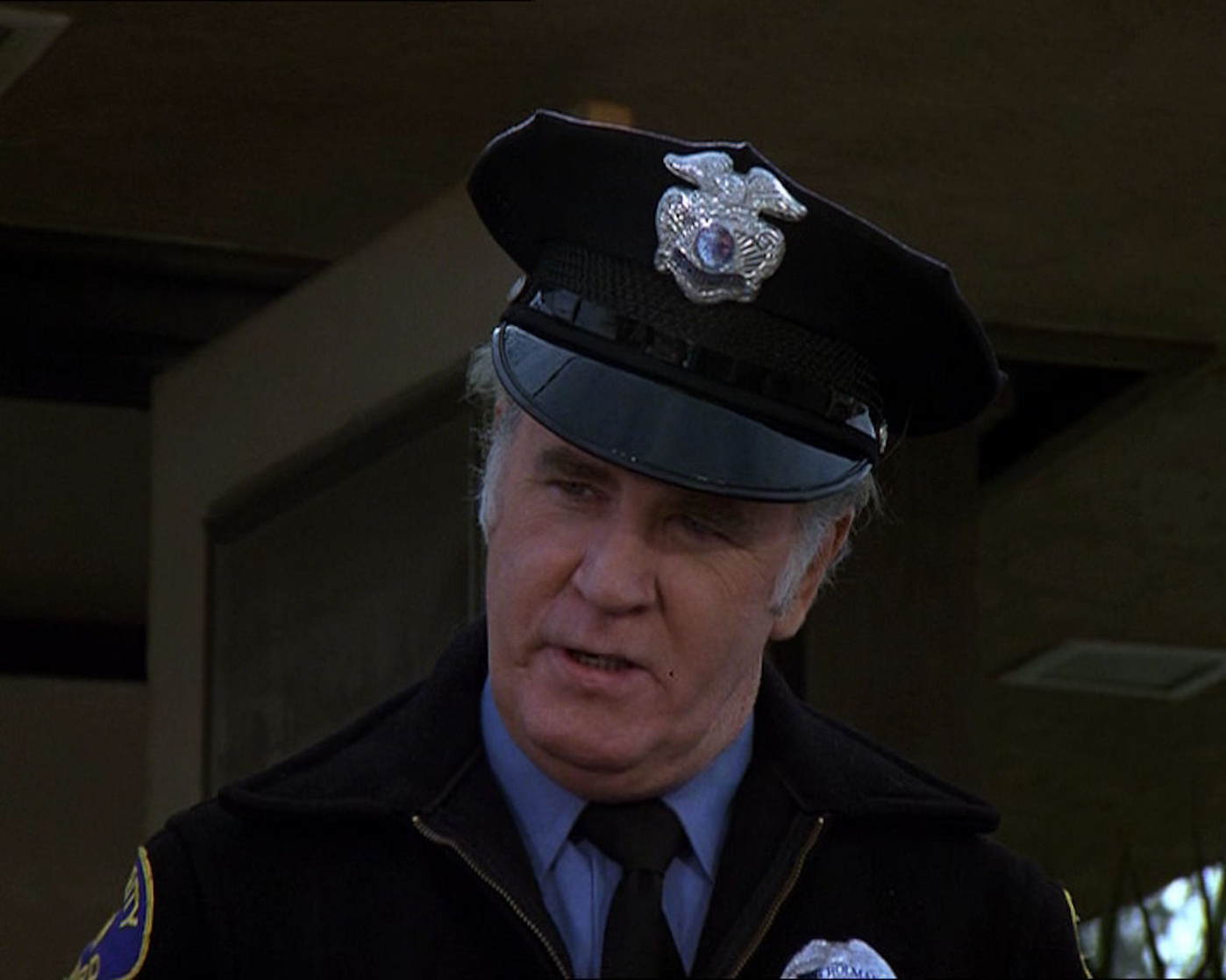
- The security guard on the bridge is a small role, but it’s capably played by Columbo occasional John Finnegan.
- Did you notice that as Columbo was rowing away at the end, that he was whistling “This Old Man”…with a cigar in his mouth? Talent!


Comments
Post a Comment